The discipline · The book · The living system
Startup
Engineering
A technical decision framework for the 0→1 journey in the AI era.
Building from 0→1 is not one software project. It is a sequence of hypotheses that have to earn the next engineering commitment. Startup Engineering helps founders and CTOs decide what deserves to be built, how much engineering the current evidence has earned, and what can safely wait.
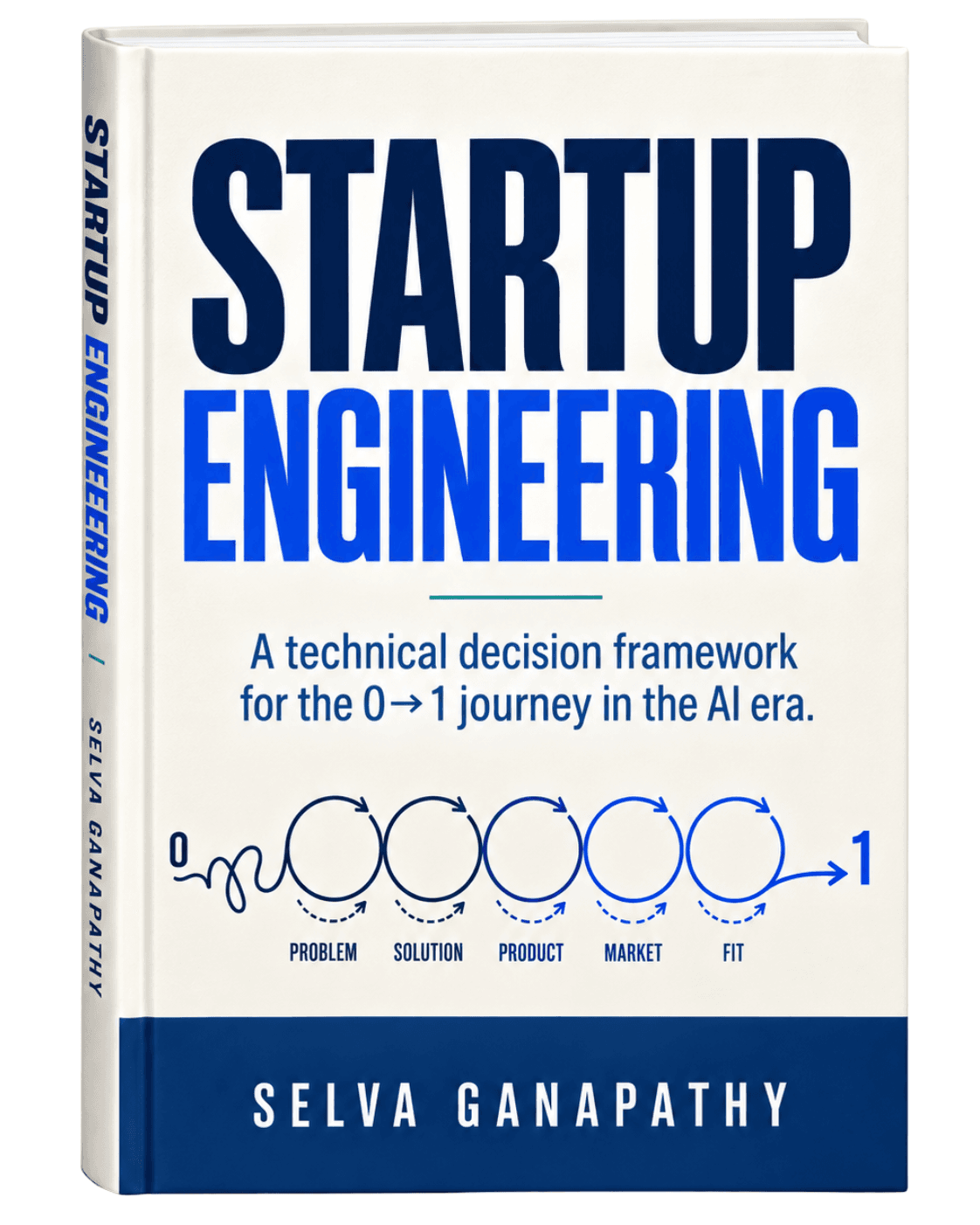
Forthcoming — launch updates go to the newsletter first.
Engineering should
follow evidence.
Conventional engineering optimizes for scale, reliability and elegance — the right criteria for a validated system. Between 0 and 1 the startup is still validating its problem, solution, product, market and fit. So the engineering bar is set by the current loop's evidence, not by the industry.
- 01Stay reversible while uncertainty is high.
- 02Buy the next piece of evidence as cheaply as possible.
- 03Don't harden too early.
- 04Later-loop questions must not consume earlier-loop attention.
- 05Good engineering is loop-relative.
The Five Loops
A startup is not one project plan. It is five evidence loops. Each is named for what it exists to discover — and in each you hold something tangible as the tool of discovery.
- At hand
- Idea
- North star
- “The problem is real and worth money.”
- Engineering bar
- Manual Delivery
- 3 decisions in this loop
The Engineering Ladder
At every loop the quality bar is set by one question: what must this thing be for the loop's evidence to be readable? Anything less blocks the discovery; anything more is payload. The answers are a ladder.
- 1 · Problem LoopManual Delivery
- 2 · Solution LoopDisposable Prototype
- 3 · Product LoopLaunchable MVP
- 4 · Market LoopObservable Product
- 5 · Fit LoopRepeatable System
The Decision Catalogue
The concrete technical decisions of 0→1, organized by the loop where each one becomes real — and titled as the questions actually asked.
- Does this need to be built at all?
- What's the riskiest thing I'm assuming?
- Will AI make this obsolete before I build it?
- How real should my prototype be — and who should build it?
- My AI-built prototype works — now what?
- Who should build my MVP — and under what agreement?
- What goes in — and what gets cut?
- Which technology? (The question behind the question)
- What can't wait?
- How do I know the build is going well?
- What does “ready to launch” actually mean?
- Ready to launch — to whom?
- What should I measure after launch?
- What happens when it breaks at 2 a.m.?
- What does one customer cost to serve?
- Is this traction — or founder heroics?
- When should technical ownership move in-house — and what should I own first?
How a decision works
Every decision is worked the same way, in six parts. The second — the determining questions — is always the load-bearing one.
- 1Decision
Stated plainly, as the question you actually ask.
- 2Determining Questions
The three to five questions that actually settle it.
- 3Paths
The options, with honest, dated costs.
- 4What I'd Do
My judgment — and the conditions under which I'd do differently.
- 5Limits
Where this guidance explicitly doesn't apply.
- 6Skill
The executable version, to run on your specifics.
Decision Skills — free.
Executable versions of the decisions. Each skill is a plain text file you hand to Claude or ChatGPT. The assistant interviews you through that decision's determining questions, on your specifics, and gives you the recommendation plainly, with conditions.
Get the skills- Free and ungated. No email wall, ever. Nothing was withheld, teased, or saved for a course.
- Your specifics, not a template. Your numbers, your industry, your quotes, your prototype.
- Every skill has an escalation clause. It names when the decision stops being self-serve. An honest tool knows its edges.
The durable framework
The book holds what doesn't change: the Five Loops, their exit bars, the Engineering Ladder, and 17 decisions worked in six parts. This site keeps it current and executable.
Explore the bookResearch. Supporting technical depth — evaluated engineering patterns, architectures and frameworks. Open the research archive →
Selva Ganapathy
I wrote Startup Engineering because most technical advice silently assumes a validated business. Between 0 and 1, nothing is validated yet — and I've made these mistakes personally.
- 20 years of product engineering, across Silicon Valley and India
- Founded a SaaS company and took it from 0 to ₹6 Cr (~$700K) ARR
- Runs production AI at 50M tokens/min
- LinkedIn Top AI Voice (Aug–Dec 2024)
- Author of Startup Engineering (forthcoming)
Some decisions need a human with scars in the room. That's what I do → selvaganapathy.io